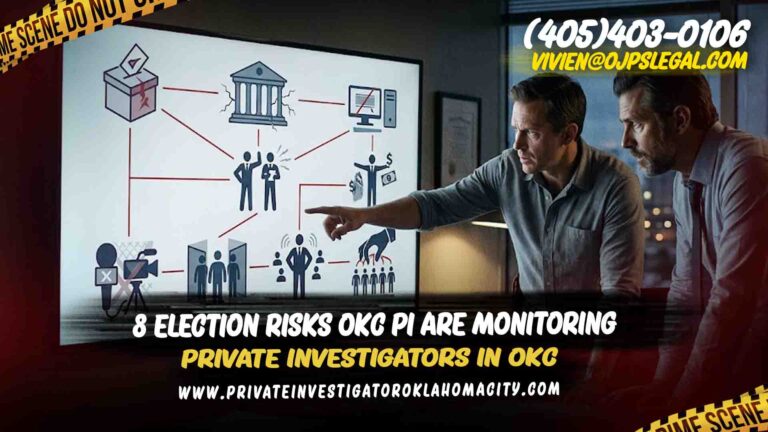
Election work is supposed to be as boring as boring gets. It needs reliable, recordable deadlines and public scrutiny that provide voters with a sense of security about the results. That’s why a majority of election private investigators in OKC have no time for any drama. They spend their efforts on paperwork, court documents, voting records, press releases, and election law because they are all objectively verifiable.
For the 2026 election, that’s going to be a much tougher job because the Trump administration has intervened in election administration at an unprecedented level. The courts, states, and voting rights groups are resisting, proponents argue about the results, and it places unusual stress on elections.
Trump’s administration was also pushing for wider SAVEchecks, seeking voter rolls from states with specific and detailed voter data. It included actions that could have centralized federal control over an area traditionally governed by state and local election officials. Courts have overturned or limited many of these actions, but it is the attempt that is concerning. Here are 8 alarming reasons why free elections could be at risk, according to an elections private detective in Oklahoma City.
1. The White House Is Trying to Push Federal Power Into a State-Run Election System
Based on OKC private investigations, the first concerning cause of action is that the Trump administration has sought to centralize authority in Washington. On March 25th and 31st of 2025, the White House passed orders for elections, verification of citizenship, and Mail voting. It says that it will encourage the integrity and eligibility of the election process. Others say this will enable the administration to interfere with elections.
It’s an important matter because people don’t want the US election administration to be dependent on the president. Both Brookings and the State Court Report make the point that presidents should not have significant roles in election administration. The role is mostly relegated to the states and Congress under the Constitution.
It is the sort of thing a Tulsa, Oklahoma, election private investigator should bring attention to instantly. If it doesn’t start with the state law and court-approved processes, it will be more likely to be questioned. If some elements are overturned, it is still spending valuable resources and time.
2. The Administration Is Demanding Sensitive Voter Data From States
The second is the Department of Justice’s pressure to obtain voter registration lists and other election data from the states. According to the AP in 2025, the Justice Department’s demand for voters and election records increased in over 15 states. Reuters in 2026 said lawsuits filed by groups like the one being represented by J. Christian Adams were filed in more than 30 states. The District of Columbia also demanded voters’ names and addresses, while courts recently blocked DOJ requests, calling them legally deficient.
According to results from targeted private investigations in Oklahoma City, both Reuters and AP characterized the requests as dealing with sensitive personal data. These are the kinds of details that election officials and privacy advocates feared when the federal government made unusual demands. The question is not whether or not voter rolls exist or not. The question is whether or not the federal government has a compelling legal justification for such wide access to them. Also, about whether these are politically-motivated demands intended to apply pressure.
The bottom line for election private investigators OK is equally simple. Don’t take a request for your data at face value simply because it’s made by an agency of the government. You must understand what claim of authority has been made and the purpose for which the information will be put. Is the use consistent with legal guidelines, and did the states object? etc.
3. SAVE Checks Risk False Positives and Unnecessary Purges
Another concern is the administration’s increased use of the DHS SAVE program to verify voter eligibility. According to AP, over 67 million registrations were verified in an administration-wide purge effort. However, the Trump administration flagged approximately 24,000 individuals as potentially non-citizens and 384,000 as potentially deceased. Critics then suggest that the numbers are small compared to the people impacted, and false positives can still be dangerous.
States such as Texas, Ohio, and North Carolina are looking to use the flags to suspend voters. They will also consider potential removal from the rolls if proof of citizenship isn’t provided promptly. The program sounds good in theory, but it seems scary upon closer investigation by private detectives in OKC. If the system generates wrong flags, then real, eligible voters may be compelled to prove their eligibility on Election Day.
AP documented one such incident, a U.S. Citizen who was wrongfully flagged and removed from the voter rolls. That is the kind of incident that voting rights proponents fear, and it’s not that the data may be inaccurate. It is that inaccurate data can spread rapidly, keeping legitimate voters from the polls.
4. The Administration’s Voting Machine Moves Look Like an Attempt to Rewrite the Rules
The fourth disturbing reason is the alleged attempts to ban/remove voting equipment based on unsubstantiated claims that collapsed. According to Reuters, Trump-appointed advisor Kurt Olsen tried to implement an initiative to ban machines from Dominion Voting Systems. These systems, utilized by more than half of all states, had a planned replacement with hand-counted paper ballots. According to Reuters, Dominion says there was no evidence of foreign interference or of threats to the devices.
Why is it important that the attempt ultimately collapsed? Voting machines are one place where public trust and the security of the systems themselves must be in agreement. The danger of allowing conspiracy theories to inform policy decisions is that you risk a less reliable, error-prone system. Reuters quotes experts who note that hand-counted systems might be more unreliable than machines that already generate auditable paper trails.
It’s a very classic trigger word for El Reno election private investigators. If an election operation, then, tries to elevate something false to security findings, who is gaining what by this shift? Are they trying to make something secure? Or are they trying to spread suspicion against the machines and hold people in a perpetual state of suspicion? That’s not election hardening, when there’s a continuous attack on voting systems with no evidence. That’s election destabilization.
5. The Mail Voting Orders Could Burden Legitimate Voters
The fifth issue discussed here is the administration’s plan to alter mail voting policies. In a March 2026 executive order, President Trump instructed all federal agencies to compile a roster of the US. Citizens who are eligible to vote in every state are verified using the federal data for verification.
According to a May 2026 Reuters article, this order endured its initial, significant court challenge. The article says that Democrats contend that the order could disenfranchise millions. Also, the Brennan Center refused to deliver ballots to citizens who are not on the new federal rolls. The argument was that the executive order requires the U.S. Postal Service to establish a list of who is eligible to mail in ballots.
This is a big concern as the postal service isn’t a polling office. The way mail-in voting works differs in each state, with formulation on their terms rather than national lists. Once you impose a new federal layer of approval on these mail-in votes, you risk delays and confusion.
Election experts always tell people the president’s role in running elections is small and ought to stay that way. The problem isn’t theoretical, since a messy federal mail-vote filter could be a major handicap for certain categories. It covers categories like the elderly, disabled, members of the military, and voters who utilize mail and absentee voting. Any election investigator in Tulsa, Oklahoma, ought to view an order designed to delay access to a ballot as inherently threatening to democracy.
6. False Claims From the Top Poison Trust in the Whole System
The sixth alarm is simply misinformation starting from Trump’s baseless claim about election rigging. He claimed that Maryland had mailed 500,000 unauthorized mail-in ballots in a bid to rig a primary election. State officials had told The AP the problem was due to a vendor error and appropriate correction procedures were in place. AP later found the accusations to be unsubstantiated, and officials were concerned they were sowing doubt.”
That’s not a minor side issue since election systems require trust. When the president publicly claims that normal administrative mistakes demonstrate fraud, trust in ordinary, usually dull and mundane, processes erodes. It’s how false narratives undermine democracy in the long run. They don’t have to win elections directly to undermine them; they just have to get people believing every glitch is part of a plot.
According to Reuters, Trump also made known his history of promoting fraudulent 2020 election stories. He also called for further restrictions on mail-in voting in anticipation of the 2026 midterms. The two actions are significant because persistent untruths aren’t just words but an agenda for the implementation of increased oversight. An OKC election investigator would do well to recognize this pattern as a predictor.
7. Election Officials and Workers Face Pressure Into a Defensive Position
The seventh problem deals with the intimidation and harassment that the people who actually manage elections have faced. The Brennan Center reported that the Trump Administration has sought to target and harass election administrators and election workers. They also said he supported anti-democratic activists challenging election administration, and disengaged from its federal role in defending voters.
A recent Reuters report found that democratic senators made requests to fire President Donald Trump’s White House security advisor Kurt Olsen. It came up a month after an inquiry revealed Olsen has reportedly served beyond the maximum limits for political appointee service. It also promoted the falsehood that the 2020 presidential election was fraudulent.
Poll workers are the front of the process since they confirm registrations, run the polling place, tabulate votes, and fix problems. If there’s a threat, investigation, or pressure, it becomes more difficult to hire poll workers and less reliable. Based on past reports from Reuters, election officials in several states are reporting that election administrators are dealing with harassment.
To the election private investigators in Oklahoma City, it’s a dangerous warning sign, because a free and fair election needs professional, bold administrators. You dont want a structure whereby people who are running fair elections are one accusation from being villains. As you punish the people running the elections more and more, the election system becomes less stable.
8. The Federal Government Itself Is Becoming the Main Election Fight
Eighth and largest alarm of all, the federal government is joining the election problem instead of being the backstop. Per Reuters, as early as in Trump’s second term, he eliminated the most crucial election-security functions. He targeted the Cybersecurity and Infrastructure Security Agency, reducing its budget and workforce.
Brennan Center reporting claims the administration is stepping back from the federal government’s role in guarding voters and the electoral system. However, they are attempting to seize control over the rules of the election process, mixing weakening safeguards while intensifying pressure.
Basically, it means the system has less defence and faces attacks where it should find stability. Less federal cyber defense means more election infrastructure exposed. Then federal agencies will act less like neutral defenders of elections and more like enforcers. More power gathers in the White House at the expense of the mechanisms that protect the election results
Both Reuters and AP confirm judges are preventing or limiting some of the administration’s more extreme election efforts. As noted by both Brookings and the State Court Report, the president is not in charge of the US elections. It’s one institutional constraint that is currently staving off further extreme measures. For an election PI, this is less about a single cycle and more about whether institutions can prevent further erosions.
Final thoughts
The encouraging thing is that fair and free elections aren’t dead and buried. Courts are still saying no, states are still taking over, and the public record is still accessible. The current approach to elections by the Trump administration is creating real strain across the entire system. Everything from federal mandates to voter roll suits, SAVE checks, pressure on voting machines, and lies-the pattern is broad enough for election PIs to pick.
If you want to see if the next election will be safe, don’t look at the campaign commercials and speeches. Do a little more private detective work in OKC with Oklahoma City available resources. Rather, look at who runs the show, the information, the machines, and who faces threats to stay silent. That is the actual story, and right now, that story is not quiet at all. It’s contentious, it’s evolving, and it’s still moving through the states and through the courts.