It can be tough to get to the bottom of an event if there is a dispute about what occurred. If a crime has been committed, there may be inaccuracies, conflicting explanations, or doubts about an individual’s actions. Personal rows can also lead to doubts.
Polygraph examination- a test used to determine the truth by recording physiological responses in response to formalized questions. An examiner asks questions while recording physiological responses to be evaluated by the examiner.
Knowing the science doesn’t necessarily mean you know the popular assumptions. It’s important to understand that a polygraph cannot determine what someone is thinking or identify lies. It simply measures the body’s reactions to certain questions.
Therefore, it is helpful to understand the distinction when determining if a polygraph examination is suitable for a legal investigation or private concern. This is also why examiner expertise, testing protocol, and analysis are significant. Prospective clients should learn the advantages and drawbacks of hiring a polygraph examiner in Oklahoma before any appointment is scheduled.
What Is a Polygraph Examination?
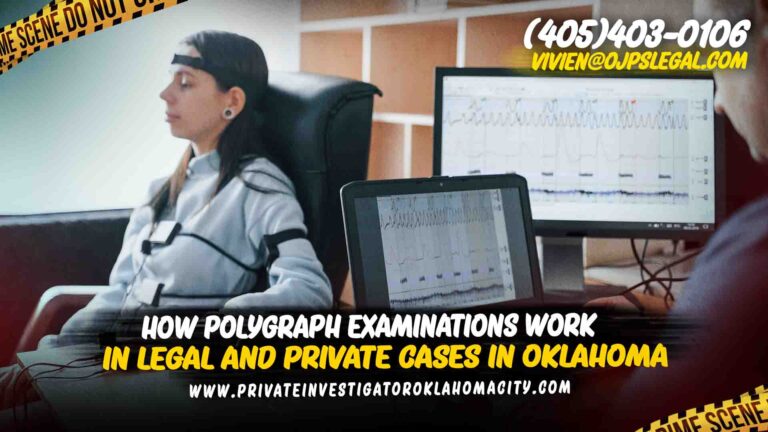
Polygraph testing involves one or more experiments during which the subject’s physiological responses are measured as they respond to certain queries. Physiological changes monitored by the device include respiration, cardiovascular activity, and electrodermal activity. The combination of these can help an examiner analyze certain trends.
Breathing is measured by respiration sensors. Cardiovascular elements are determined by pulse and blood pressure. Electrodermal responses are based on signals from sweat gland activity (skin conductance), where alterations can occur when experiencing emotional or physical arousal.
It has no information as to the reason for a response. Stress, fear, embarrassment, anticipation, etc., all influence the same systems. A truthful person may react strongly to a sensitive question while a deceiver may show no apparent change. The examiner is thus looking at the entire examination rather than making a single change a proof of deception.
The Science Behind the Measurements
Lie detector tests operate on the assumption that there are questions to which one responds differently. In a test, the examiner compares the response to the questions asked in a specific order. The way that these responses are being scored is dictated by the testing technique.
Changes in respiration, pulse, blood pressure, and skin conductance may warrant notice. No one measurement alone can determine if someone is lying. Physical conditions, anxiety, medication, discomfort, and emotional significance of a particular question can all impact measurements.
This makes polygraph analysis more complex than simply reading a line of writing on a screen. The examiner must factor in the exact wording of each question, how well the examiner and examinee understood it, the quality of the recording, and the methodology used to decide the score. Some specific-incident techniques can be effective under certain conditions.
The results of one type of test should not be used to infer the results of every other use. In general, screening tests introduce more uncertainty than testing a specific event. An expert should report these limitations accurately. Claims that the polygraph is correct every time or has no room for error are unrealistic.
How a Professional Examination Works
The professional test typically comprises an initial consultation, pre-test interview, sensor application, presentation of questions, chart recording, and data analysis. The quality of each of these phases of the procedure can have an impact.
The consultation explains the reason for requesting the test. The examiner asks the question, “Can the problem be put into clear, focused questions?” An overly broad problem, such as Is she an honest person, is not appropriate. A question about a specific incident or action gives a more focused target.
For the pre-test interview, the examiner introduces the procedure and familiarizes the subject with the questions. The wording of the questions should be clear, and the subject should be able to indicate legitimate concerns. Unclear words should be explained before the test.
Next, the examiner places the required sensors and provides instructions to the subject as to how to respond. Questions are asked in the method of choice while the instrument records physiologic responses. In several methods, sequences are administered more than once to gain more recordings.
Following the assessment, the examiner will interpret the charts according to the scoring or decision rules of the procedure. The results can be spoken and/or written. The examiner should describe what the results indicate and comment on any limitations of the assessment.
Why Question Formulation Matters
Questions are the core of any polygraph test. They need to be worded in a way that can be both easily understood and connected with the question at hand. If a question is not well-phrased, this can introduce unnecessary confusion and difficulty in evaluation of answers.
For example, a question of whether someone has ever stolen anything is far too wide-ranging. A question that relates to a particular object, incident, and time period is more focused. The examiner may need to clarify terminology and precisely what conduct the question covers. Certain testing procedures incorporate the relevant questions related to the issue with the comparison questions.
The categories fulfill various roles within the procedure that is being used. Rather than taking for granted that all polygraphs use the same list, the examiner should simply outline the broad framework. Pre-test questions help to avoid errors in thinking. A person might mishear a word in a different way than the examiner. The pre-test interview allows the examiner and subject to sort that out.
Understanding Polygraph Results
The polygraph findings are subjective indices of physiologic responses, and not observations about truthfulness. Various scoring techniques, various markers, and various terminology contribute to recording the polygraph findings. Some reports categorize the findings as deception or no significant indication of deception.
An inconclusive result is also a possibility. This occurs when the examiner is unable to reach a conclusion with enough support based on the procedure used. This does not necessarily mean that the person has lied, nor does it prove that the person told the truth.
Having a good answer to one question is not sufficient to decide an outcome. The examiner looks at the overall pattern across the examination and decides whether the recordings are suitable for analysis, and whether there were any technical problems, unclear questions, or other circumstances.
A responsible examiner will say out loud what the result is. Consumers need to ask the basis of testing, the test method, the implications of that conclusion, and what it isn’t capable of proving. Consumers should never attempt to read the charts and can’t attempt to interpret the result from the face of the examiner.
Polygraphs in Criminal and Civil Investigations
Investigators can use polygraph tests if witnesses disagree or if there is a particular matter without a resolution. A test can help to address a matter and determine whether it warrants further examination. The test itself does not provide all facts of a matter.
A positive finding does not confirm a complete alibi or confirm every statement a person has made. A negative finding does not replace physical evidence, witness statements, documents, or other investigative activities. The investigator should regard testing as one potential source of information. There are also significant limits on the use of polygraph results in the courtroom.
Oklahoma courts have typically excluded polygraph results in both civil and criminal cases, with the Oklahoma Supreme Court finding in a 2009 decision that also recognized the investigative function of examinations. The state’s criminal appellate courts have also kept a tight rein. Any person involved in litigation should consult a lawyer prior to testing.
A lawyer can advise on whether a test may have a bearing on the case and if some other investigative step would be more appropriate. Rules vary in federal court and other jurisdictions. Expert evidence standards do not automatically allow polygraph evidence. The court will look to the rules of evidence and the facts of the case.
Private Uses of Polygraph Testing
Not all testing has links to a criminal charge or lawsuit. Testers may simply have a particular question that they need to address in a personal, family, or business situation. Its effectiveness in such cases depends on the question, testing process, and the expectations of the participants.
With relationship issues, someone might think about voluntarily taking a polygraph exam after having a disagreement or an incompatible version of the facts. The questions need to focus on a specific issue and not broad, personal character judgments. A polygraph can’t restore trust or determine if a relationship should last.
The employer may also have concerns about missing property, contested transactions, or suspected wrongdoing. Nonetheless, employers cannot require applicants or employees to submit to a lie detector test. Generally, federal law prohibits the use of polygraph tests by most private employers in employment matters, except under specific circumstances.
Legal advice is necessary prior to conducting any testing in the workplace. An investigation of the records, audit, interview, and other evidence may better suit the needs of the business. Never base an employment decision on a polygraph result.
Family and private conflicts need the same level of attention. A test cannot decide which parent will get custody, resolve financial issues, or replace legal advice. Anyone thinking about testing needs to be aware of its limits and not be subject to pressure, threats, or bribes for a result.
Accuracy, Errors, and Limitations
The accuracy of the lie detector is still under dispute. Depending on the method of testing, the study design, the examiner, and situations, research results differ. Scientific analyses establish the advantages of some specific incident tests over chance. However, a single accuracy rate does not guarantee accuracy in all the various situations. A false positive is giving a deceptive opinion to an honest person.
Poor results can occur as a result of fear, stress, pain, medical conditions, or the importance of a question to the subject. A false negative is the situation when the victim of deceit gets a verdict that he’s not deceiving. This is one of the reasons why a positive result does not necessarily mean that there are no false positive statements. A further drawback is inconclusive results.
The examiner will need to state the limitations of the result, and whether any follow-up testing would be necessary. Clients should be wary of 100 percent claims with respect to accuracy. No examiner can say for certain that they will detect every lie, and not every non-liar will receive a clean bill. The truth is that we have to know what the test is capable of.
Choosing a Qualified Polygraph Examiner in Oklahoma
It’s important to remember: during the entire process, the examiner’s training and judgment count. You need a professional who is familiar with physiology, interviewing, asking questions, instrumentation, reading charts, documentation, and ethics. If you have instruments, that doesn’t make you qualified.
Oklahoma has a State licensing system for polygraph examiners. Qualifying applicants who meet age, citizenship, character, and education or qualifying investigative-experience criteria may receive licenses. Also, they complete approved polygraph training for six months or more of internship training and the required competency examination.
Licensing at the state level is not the same as being certified or affiliated with a professional association. The association credential speaks more to a person’s professional standards and experience, but it does not substitute for the authorization that they receive at the state level.
When considering a polygraph examiner Oklahoma service provider, verify that their license is up to date and their place of training. How much experience do they have? How do they prepare questions? Do they give a report?
Some other questions to ask of a lie detector test OKC provider are: Can the person delivering the test describe the technique without promising a specific result? Does the company advertise certified polygraph testing? If so, find out which organization is responsible for awarding the certification and how to verify it. A good expert should be happy to answer these questions.
Preparing for an Examination
It is not proper to prepare for the test by trying to manipulate the instrument. Prepare by reading about the process and understanding it. Before the appointment, state the problem as clearly as possible and ask questions about anything you do not understand. Listen to the questions in the pre-test interview.
Inform the examiner if you have any medical problems, whether you are taking any medication, and if you are in any pain or have other reasons why you might not be able to do an exercise. Do not hide any of this information in case it causes an adverse result.
Rest well beforehand and come early enough so that you can complete the appointment. Follow the technician’s instructions and answer appropriately. Do not engage in breathing tricks, discomfort, physical movements, or other attempts to distort the recordings. Be aware of who will be receiving the findings and who will be doing what with the report. If it is for legal proceedings, discuss with your lawyer prior to making the appointment.
Final Thoughts
Polygraph testing involves a mixture of measurement, questioning, and expertise. A polygraph may assist in examinations and private conflicts about particular issues, yet it offers significant scientific and legal restrictions. The tool is for assessing respiration, heart rate, and electrodermal activity. It does not directly detect lies nor elucidate each physiological response.
The examiner should analyze the trends of the chosen test method. A good exam requires good questions, good preparation, consistent testing, and expert analysis. False positives, false negatives, and inconclusiveness are always a risk; no good practitioner should promise absolute certainty. Oklahoma also mandates the licensing of professional polygraph examiners. Oklahoma courts have generally denied the admissibility of polygraph results in civil and criminal matters, despite the probative value of the examination.
If you think you have any interest in polygraph test certification, make sure to check the licensing of the examiner in Oklahoma and be clear about what the test should accomplish. Consult a lawyer if your case is still pending. Whether you are looking at your own problem or are trying to be helpful on a case, making informed choices is important.