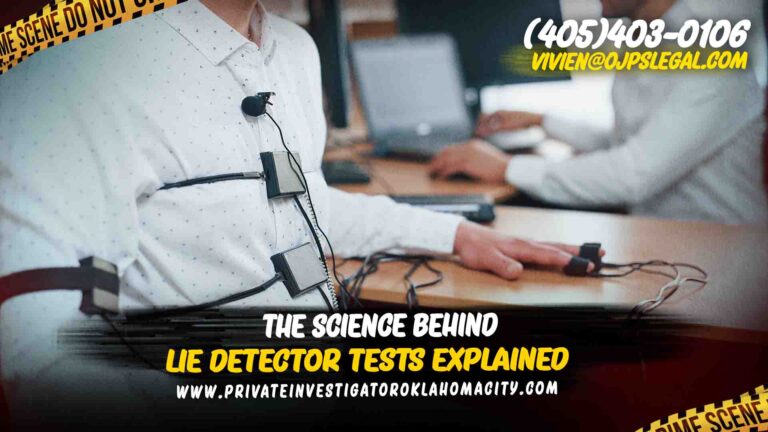
The science behind the Lie Detector Test in Oklahoma City is more complicated than movies have made it out to be. A polygraph doesn’t truly detect a lie. However, it picks up a person’s physiological responses to a precisely designed set of questions.
These responses can be related to breathing, cardiovascular functions, and the skin’s conductivity. The examiner will further examine the results with the questions and the situation during which the test was administered.
The key is how they know when the answers people give are not what they actually believe to be true. Science, not a little box. It comes down to examining the body’s reaction to such pressure or emotion. However, other factors may give evidence of the exact same reaction. It may not necessarily indicate truth-bending, but the reaction is what matters.
What A Polygraph Actually Measures
The term ‘lie detector’ gives the impression that the device is perhaps easier to use than it actually is. It is untrue to say that a sensor on the polygraph measures deceit. The device actually measures various physiological signals that could change when questioned.
The systems used currently measure respiration rate, heart rate, and skin conductance. The outputs take form in the charts that the examiners then review.
Respiration sensors record an adjustment in a person’s breathing pattern. The Cardiovascular sensors document changes in pulse charge and stress position. Electrodermal sensors report an adjustment in the electrical conductivity of the person’s skin.
The actual gear documents this during the entire exam. The examiner, after that, differentiates the physical activity connected with issues. This perception is the starting point for polygraph sciences.
The Connection Between Stress And Physiology
The science involved goes way back to how your body reacts when there are indications of stress. If people become emotionally anxious, the automatic part of the brain could get hyperattuned. It takes care of basically all your unconscious responses. For example, heart rate and breathing could be faster or shallower than normal.
Increased perspiration would happen if you felt you were in danger, were worried, nervous, or overwhelmed by something you said. A polygraph attempts to measure a portion of the reaction.
The Role Of The Autonomic Nervous System, Respiration, and Polygraph Testing
The autonomic nervous system plays an important role in the physiological reactions, which are often measured by polygraphs. Autonomic functions regulate heart rate, respiration, digestion, and sweating. The system automatically reacts to new stimuli. A person may unknowingly trigger the autonomic reaction as a result of stress.
These responses are a normal bodily reaction to perceived pressure. Polygraph testing records this physiological activity as data. The problem is that lying isn’t the only phenomenon that will activate these systems. This is a critical scientific drawback to polygraph examination.
One of the physiological signals monitored during the polygraph test is respiration. A sensor is typically placed on your chest/stomach region and may sense fluctuations in a person’s normal respiration. The polygraph examiner can watch for shifts in breathing rates and cycles in their patient when stressed.
Breathing can, of course, vary for all sorts of reasons. The person might roll over in bed or might be too warm. The patient might just feel anxious about being examined. So variations in breathing should be compared with whatever else is recorded. It is the study of a pattern, not a single measurement, that will give the power to the examination.
Why Deception Can Produce Physiological Changes
For some, Deception may result in psychological stress. A subject who intentionally lies has the fear of detection, resulting in heightened arousal or excitement. This added arousal often results in detectable physiological correlates. Polygraphic measurements attempt to reveal behavioral patterns, including such heightened arousal, that are specific to relevant questions.
This is not true for everybody since you might not feel a significant stress level lying on your back. You might even feel extremely stressed, to tell the truth. This is the reason why a professional examiner could not tell you that there is a spike and you are lying.
Cardiovascular Responses And Electrodermal Activity
Cardiovascular activity is also evaluated. This may include measures of heart rate, blood pressure, and pulse. Elaboration on a particular event may elicit a response in cardiovascular behavior. The impact of the arousal of the subject’s response to stress upon the heart and blood vessels. Note that these measures do not target deception per se.
The body’s cardiovascular response can change as a reaction to being nervous, fearful, irate, or mixed up. So the examiner is going to be looking for fluctuations from question to question as well as the fluctuations between the test and a comparison baseline. This is the reason that effective question construction is so crucial for the measurement of electrodermal responses.
This indicates the rise of skin electrical conduction that corresponds to gland activation. Visible perspiration does not have to appear in person; the electroconductivity of skin will also rise with sympathetic nerve excitement. A polygraph can record the changes.
Just as respiration and cardiovascular responses are not unique to lying, so are electrodermal responses. The electrodermal response represents physiological arousal and must be interpreted within the context of the overall examination rather than as a measure of deception.
Why The Questions And Pre-Test Interview Matter Scientifically
Question design is not just about the words used; it’s fundamental in polygraph technique; the polygrapher has the task of ensuring a set of questions that yield a valid contrast. Significant questions explore the matter under investigation, and comparison questions provide an alternative point to which the response can be made, depending on the testing protocol method being used.
The principle of it all is getting you to respond to the questioning, but under different questioning conditions. You would have difficulty knowing what a physiological reaction means without those set questions. That science is embodied in the examination structure too, not only in sensors. Pre-test interviewing, too, has scientific significance.
The examiner talks through the topic with the examinee before starting the chart collection phase. This also helps the examiner work out exactly what was being asked during the event and the important background details. The questions are also generally explained so there is no doubt about the intent, and to give the examiner the necessary context around the study.
You might seem upset by a question because the question reminds you of the event. It’s not because you’re lying. In order for somebody to figure out what is happening in the situation, a real Lie Detector Test Oklahoma City exam would have to be supplemented by some kind of preparation.
How Truth-Telling And Calm Liars Affect Physiological Responses
Honest answers still cause stress. An example is when someone accuses you of doing something terrible (say, stealing a company’s secret recipe). Someone then asks if you did it. Even though you were completely innocent, that feels like a threat. Your breathing rate changes. Heart rate goes up. Skin conductivity increases.
All of these readings are stored in the polygraph. This fact contributes to one of the major difficulties with the use of the polygraph. Although there is indeed a reaction (physiological), the cause is not necessarily untruthfulness. This requires a skilled operator to attempt to analyze the situation correctly. Still, another possibility exists in the “opposite”. The person might lie without any notable distress.
People can give misleading information in a normal, calm manner. The lack of excessive physiological reactions doesn’t confirm that the information you receive is true. The entire process needs to be analyzed once more. Scientific understanding doesn’t state that everyone will show signs of nervousness when lying. Another thing that is exaggerated and stereotyped in movies.
The Role Of Psychological Pressure And Professional Examiners
The psychological meaning of questions contributes to the science of polygraphy. It can cause some physical reactions. What we are testing matters, and irrelevant or fuzzy questions should therefore produce no helpful results.
A thorough test results in an organized association between the question, the relevant issue, and the documented answer. The polygraph instrument collects information. The examiner interprets that information. This interpretation does not include the option to arbitrarily select a desired outcome; it requires knowledge of the test procedure, question format, measures utilized, and any of the factors that could contaminate or impact the test results.
Training is important, as many complex patterns on these charts may occur in charts of a novice, and a properly trained person may mistake some regular body processes. A trained interviewer is better, as you can identify different sources of possible deception. Professional qualification is something important that you check when you visit a provider of a Lie Detector Test in OKC.
What Happens During Chart Collection And Why Multiple Charts May Be Necessary
During the testing procedure, the sensor should continuously register physiological data. The questions in the selected testing procedure follow a routine at programmed intervals. The system registers the alterations that occur as the testing procedure moves along. It is possible that the resulting testing procedure has a whole number of charts.
The examiner then moves on to comparing the relevant answers and the comparison answers together. The goal of this stage is to create a set of answers that can undergo scientific analysis. It follows this structure in this manner because if the questions come up randomly, it becomes extremely difficult to compare answers fairly. One chart might not be enough; the actual body responses can change constantly from moment to moment in a normal person.
Multiple charts help the examiner detect any patterns that show up across several tests. A reaction that seems present once and vanishes upon retesting might therefore warrant a different interpretation than one that is clearly present time after time. That does not eliminate uncertainty, but adds the need to add that to the mix of considerations.
What Causes False Positives And False Negatives?
A false positive is when you have found deceptive signals even though the suspect was being truthful. A number of reasons can occur. A truthful person may experience acute nervousness in anticipation of the accusation put to them. May feel the ramifications of misinterpretation. Having a physical condition that produces the physical responses during questioning can cause this as well.
All of these could be explanations for why polygraph results cannot avoid flaws and faults. Science dictates these limitations. A false negative is when a person is deceitful, but the test does not show the deception. This could occur because not all individuals react to stressful situations differently.
Others might have a lesser reaction. There are other factors to consider, for example, as explained, in how the results can be misleading. For that reason, any mention of a 100% accuracy claim cannot be verified. The polygraph examiner should let you know of its limitations.
The Importance Of Standardized Procedures And Test Conditions
As the procedure gets more predictable, so can a measurement of that procedure. Such procedures make the polygraph technique beneficial and require examiners to use a standard process when preparing for, questioning, attaching to, and examining someone, obtaining and analyzing polygrams, and so on. Standardization reduces variability for unnecessary causes, yet allows for judgments of validity within the framework used to evaluate the data. These standardized tests are still unable to guarantee infallible results. They only improve and standardize examination accuracy.
Final Thoughts
The science behind a Lie Detector Test in Oklahoma City is Human physiology. Polygraph machines, in fact, measure certain bodily functions such as respiration, cardiovascular activity, and the skin’s conductivity that may react to stress or coercion.
Lying does create this pressure in certain contexts. But so do fear, panic, anger, humiliation, and more. Thus, a polygraph does not directly discover lie from lie detector. The tests are complex, involving the systematic administration of questions and controlled conditions, along with analysis of physiological data by trained individuals.
Instead of counting a single reaction, an experienced examiner takes into account the entire pattern of reactions. It can have some value in specific circumstances, but it’s not 100 percent accurate. Inconclusive results, false negatives, and false positives are still possible. If you’re thinking about a lie detector test in OKC, enter with realistic expectations.
There is also a Lie detector reaction when you’re taking a detector test. Tulsa ok service for other parts of Oklahoma. The overall lesson is really simple. Polygraphs track your body’s reaction to a question. Once you understand that one thing, you can far more easily evaluate the technology itself.